Thursday, 16 January 2014

Art of the Week: From an Ethnographic Museum Series

Hannah Höch, Untitled from the series "Ethnographic Museum" (1929)
Click here for image URL

Hannah Höch was one of the few woman artists from the Dada Movement. After a development in the collage-making technique she developed the series "Ethnographic Museum", where she produced some of her most well known pieces. The collages juxtapose mainly of women with ethnographic objects, like tribal masks, and usually incorporate plinths and other elements used for presentation. These pieces are simultaneously beautiful and monstrous, and deals with ideas of exoticism and colonial aesthetics with emphasis, mainly, on the figure of the woman. Though never publicly criticising racism or colonial ideals, her photomontage clearly criticises such topics. Her pieces emphasise cultural and racial differences and how all may come together.*

A main exhibition of her works are shown today at the Whitechapel Gallery.


*Based on Whitechapel Gallery exhibition text on "From an Ethnographic Museum".

Thursday, 9 January 2014

Art of the Week: Composition C (No. III) With Red, Yellow and Blue

Piet Mondrian, "Composition C (No. III) With Red, Yellow and Blue" (1935). Tate Modern Collection, Structure and Clarity Exhibtion. Click here for image URL

Mondrian's worked developed into the beauty of the bare minimun. In the series of his more mature compositions, canvases consists of white background, vertical and horizontal black crossing lines, and the use of red, yellow and/or blue. In other terms, rectangles and squares and primary colours. Mondrian believed colours did not need to mix nor lines need to bend in order to achieve pure beauty. He isolated all other artistic techniques in order to provide a pure mathematical study of the beauty of art.

The essence of Mondrian’s ideas is that painting, composed of the most fundamental aspects of line and colour, must set an example to the other arts for achieving a society in which art as such has no place but belongs instead to the total realization of ‘beauty’.*


* 2009 Oxford University Press. MoMA, the collection - about the artist Piet Mondrian.

Thursday, 12 December 2013

Art of the Week: Cottingley Fairies

Elsie Wright, "Cottingley Fairies" (1917). Click here for image URL.


Elsie Wright took this picture in 1917: A shot of Frances Griffiths posing while surrounded by fairies. Almost 100 years after the invention of photography, people started to understand how to ‘edit’ and create imaginary scenarios.

The cut-out fairies were placed in the setting where the picture would be taken. Though for us it seems so obvious to be a man-made intervention, at the time, people believed these fairies to be real. Photography was used to document reality, and it was its main purpose at the time, even if used for artistic intent. Once the fairies were seen in a photograph, it was to believe they were real, because all other elements of the picture were too.

Thursday, 5 December 2013

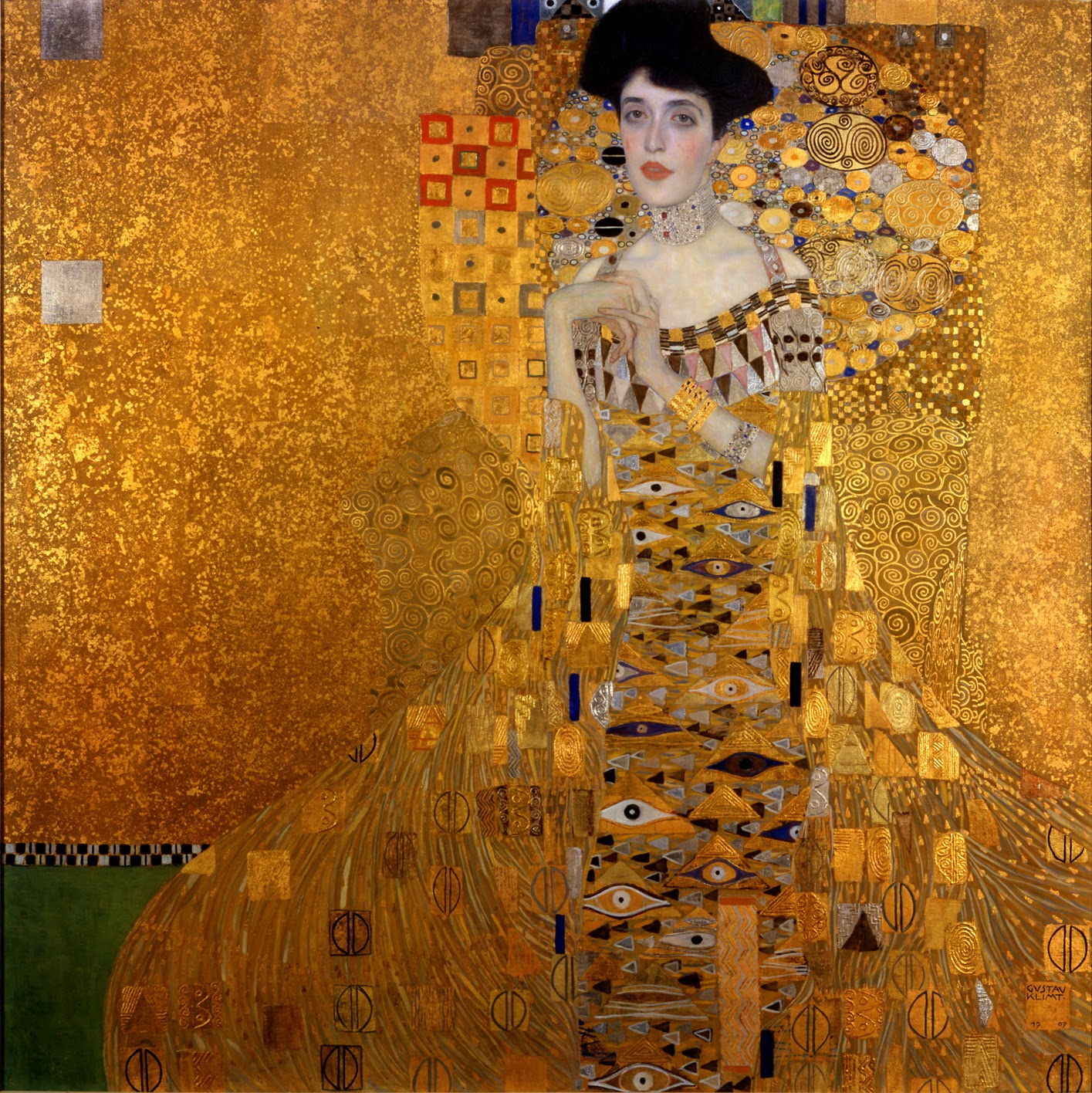
Art of the Week: Portrait of Adele Bloch-Bauer

Gustav Klimt, "Portrait of Adele Bloch-Bauer I" (1907). Neue Galerie, New York.
Through the making of this painting, Klimt and his model had an affair, and its analysis indicate elements of this happening. The positioning of the hands shows a possible maliciousness, of waiting for something to happen. Her face, though neutral, is powerful. Her dress contrasts from the golden background with the almond-shaped eyes, a motif with sexual connotations.

As the son of a gold smith, Gustav Klimt is best known for the gold work he uses in his paintings. This portrait of Adele Bloch-Bauer and its second version mark the fullest point in the Viennese artist's golden phase. Ferdinand Bloch-Bauer, the model’s wealthy husband, commissioned this portrait. Years later, the Nazis took the painting from the family.

After the repossession of the painting to the Bloch-Bauers, to the Altmann's family, the painting was sold at a Christie's auction in 2006. This was a ground-breaking sale, of $135 million, then, the highest price paid at auction for an artwork. The painting was taken to the Neue Galerie, in New York, where it is now their "Mona Lisa". 

Monday, 2 December 2013

Artagram: hansulrichobrist


Instagrams of artists and people engaged in the arts that are worth checking out!

Hans Ulrich Obrist is Co-director or Exhibition and Programmes, and the Director of International Projects of the Serpentine Gallery. Through his Instagram, he collects written frases and quotes by famous artists and people, hand written by them. 

Instagram: hansulrichobrist

"Olafur Eliasson + Ai Weiwei MAKE YOUR MARK ON THE MOON Your Mark Matters"

"Etel Adnan Art is one of the roads to Paradise."

"Charlie Fegan THIS WAY TO THE REAL WORLD"

"Stefano Boeri DO MORE WITH LESS"

"Heman Chong THINGS THAT DON'T BELONG"

Thursday, 28 November 2013

Art of the Week: Death of Marat

Jacques-Louis David, "The Death of Marat" (1793). Royal Museum of Fine Arts of Belgium.
Click here for image URL
"The Death of Marat" is possibly one of the most influential paintings of the 18th Century, if not, History. Jacques-Louis David, a court painter for Napoleon, was influenced by the Classical art of the Romans and Greeks. This painting portrays the death of the Revolutionary Jean-Paul Marat, a member of the Committee of General Safety, who was assassinated by Charlotte Corday. Marat suffered from eczema, a skin condition that demanded he should bathe in oatmeal as a treatment - a place he sometimes worked from. The woman did not flee after his death; instead, she stayed by his side, waiting for someone to find them both. Two day later she was executed.

Though depicting a scene of murder, with a cut on Marat's torso, the painting has a contradictory calming mood through the use of cool earthy colours. David used elements of historically known figures, like Michelangelo's "Pietá". By comparing Marat to Jesus, the artist gives an aural quality to both the man and the painting, creating an environment of holy. Though a recent happening at the time of its making, this painting could be considered to have a historical connotation through its Neoclassical style. By using a sculptural positioning of the subject, he enhances the political views of the revolution in a whole: the repetition of grandiosity of the Roman Empire through its classical elements.

Edvard Munch, "The Death of Marat I" (1907).
Click here for image URL.
TJ Clark considered this painting to be the first modernist artwork, for "the way it took the stuff of politics as its material, and did not transmute it". Though a contradictory statement, this painting has influenced several artists to recreate this scene, and discuss its details. Edvard Munch, for example, has created a series of paintings depicting the subject of the revolutionary's death, though using his own understanding of the happening. He believed that even though Marat and Corday were enemies, the man surrendered to the desires of the female figure, who then stuck him. This painting in the other hand, is much more chaotic and intense than the one produced by David. 

Monday, 25 November 2013

Artagram: cintascotch

Instagrams of artists and people engaged in the arts that are worth checking out!

Javier Pérez, also known as cintascotch, is an amazing graphic designer and artist who creates images and movies out of random household objects and food recreating the function out of random objects. Check it out, and follow him!

Instagram: cintascotch
Website: javierperez.ws/

"Grape Balloon"

"Mini Violin"

"Pulmones de mandarina"

"Mosquito"

"La navaja suiza de MacGyver es un clip"

"Tanclip"

"Perfil de gancho"